Top Signs You Need Garage Door Service – Don’t Ignore These
A door that takes two seconds longer to open than it did six months ago isn’t “getting old.” It’s telling you the spring tension is off, and in South Florida’s heat, that stress accelerates faster than it does almost anywhere else. Most expensive garage door failures announce themselves weeks ahead through sound and movement that homeowners wave off because the door still technically opens. The tell is usually the number of garage door service visits it takes for a small, inexpensive problem to turn into a serious repair. If you don’t want to be the one diagnosing it, call (877) 792-6497 and we’ll take a look.
Key Takeaways
- Garage doors rarely fail without warning. The warning is a sound, a slow spot, or a change in how the door sits when closed.
- A failing torsion spring, worn rollers, and a struggling opener motor each produce a distinct sound. A trained ear tells them apart.
- A door that’s slightly off-level when closed points to cable wear, not cosmetics. One storm season ignored can turn that into a snapped cable.
- The whole system is under hundreds of pounds of tension. Spring, cable, and opener work is not a DIY job, and we mean that plainly.
The Sound of a Spring About to Fail vs. Worn Rollers vs. a Struggling Opener
These three problems sound different, and once you know what to listen for, you can usually tell them apart from the driveway.
- A failing torsion spring produces a sharp metallic pop or boom you feel in the floor, then the door won’t lift or lifts crooked. Before it breaks, you may hear a single loud snap from the garage followed by the door refusing to move.
- Worn rollers give you a low, steady squeal or rumble that rises and falls as the door travels. The door still works; it just sounds like a train with bad brakes.
- A struggling opener motor sounds labored: a grinding or straining hum, sometimes with a brief hesitation before the door moves. On chain drives, a stretched chain adds a slap-and-rattle to the mix. Genie and LiftMaster units that suddenly sound louder often need a sprocket, gear, or chain refresh rather than a whole new motor.
In our experience, Hollywood humidity and heat push springs and opener gears harder than a cooler climate does, so these sounds show up sooner than homeowners expect. If the noise is new and repeatable, it’s worth a look before it turns into an emergency.
Why a Door That Slightly Off-Level When Closed Points to Cable Wear
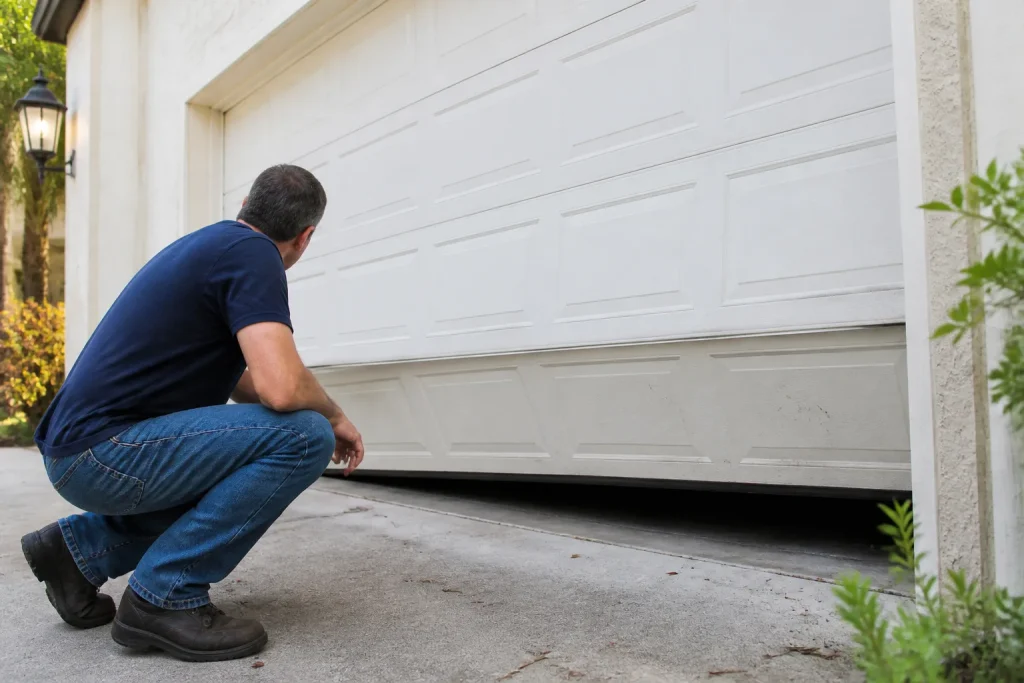
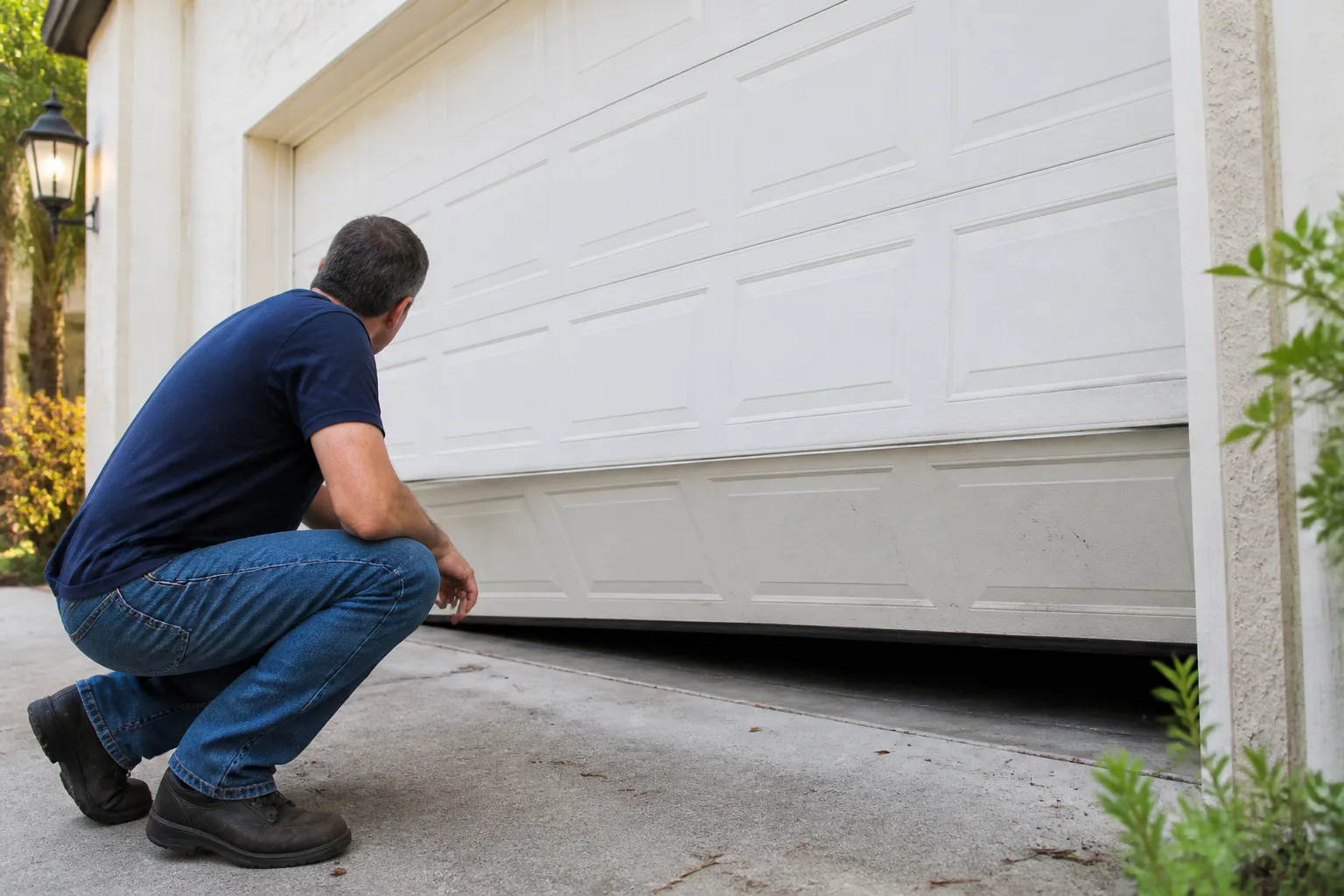
Look at the gap under the door when it’s fully closed. A consistent gap along the whole bottom is normal. One side sitting half an inch lower than the other is not a cosmetic quirk. It usually means one of the cables has stretched, slipped a drum groove, or begun fraying, and the two sides are no longer lifting the door at the same rate.
Cables are the quiet workhorse of the system. They spool around drums at the top of the door and must run perfectly even. Once one side is off, the door twists slightly as it travels, and every cycle works the cable against the drum a little harder. Through a South Florida storm season – the winds, the rain pushing at the bottom seal, the metal moving and setting again – a frayed cable can go from “still working” to “snapped” without much warning. A snapped cable drops one corner of the door. That can bend a track and sometimes yank a panel out of square. What costs one cable now can cost a full track-and-panel repair later.
If your door is visibly out of level, don’t run it up and down “to see if it gets better.” This is exactly when a trained professional should look at cable drums and brackets. If you’d rather not guess, our garage door repair team handles cable work in Hollywood.
The “Door Reverses for No Reason” Symptom: Sensor or Spring?
A door that goes down and then jumps back up is doing its job. The safety sensor sees something in the path, or the system thinks it does, and reverses. The question is whether the sensor is actually at fault or whether it’s masking something else.
Start with the simple stuff. A sunbeam hitting the photo-eye, a cobweb or leaf in front of the lens, a knocked sensor bracket, or a crooked track that pushes the door out of alignment all trigger a false reversal. Clean the lenses and check that the brackets are square. If that clears it, the sensor was fine and the door is fine.
But when the sensor is clean and aligned and the door still reverses, look at how it moves. A door with weakening springs often travels unevenly and the opener’s force limits trip as a result. That reversal isn’t a sensor problem at all. It’s the spring and opener telling you the tension is wrong. On a smart-home or Wi-Fi connected unit from Chamberlain or Genie, the app’s force or obstruction codes sometimes point right at this. If a reversal keeps coming back after a basic sensor check, it’s time for a professional look before the door stops mid-travel for good.
The Visual Inspection You Can Do in Under Two Minutes
You don’t need tools to catch most imminent failures. Step inside the garage with the door closed and look at two things: the bottom bracket bolts and the cable drums at the top.
- Bottom brackets. These are the L-shaped plates at each bottom corner of the door where the cables attach. Check for loose bolts, cracks, or visible rust around the bolt heads. Looseness here means the cable is pulling unevenly.
- Cable drums. Look at the pulley-like wheels at the top of each side. The cable should sit neatly in a groove with no frayed strands, kinks, or cable spilled over the edge.
- Ask yourself the real question: does the door feel heavier on one side when you lift it a few inches? Don’t fight it. Just note the answer.
If anything looks loose, frayed, or uneven, call before you run the door again. Do not try to tighten or adjust a bottom bracket or cable drum yourself. Both are under extreme tension from the springs above. That’s the one part of a garage door where we’ll tell you, honestly and without drama, that an injury is far more likely than a successful fix.
Why Hollywood’s Salt-Air Air Bites Bottom Seals and Brackets
Hollywood sits close enough to the coast that the air carries salt, and salt loves steel. The parts most exposed to it are the ones you can’t see well from inside the garage: the bottom seal, the bottom brackets, and the hinge points along the base of the door. Rust starts on the seal’s metal retainer and creeps into the brackets. From inside, everything looks fine until the seal cracks loose, water gets behind it, or a bracket gives way.
That’s the invisible damage homeowners here walk past. A quick look from the outside, where the bottom of the door meets the driveway, usually reveals rust staining or a curling seal that tells the real story. If the door is a Wayne Dalton or Amarr model, the bottom seal and bracket design varies, so it’s worth matching a replacement to the door rather than forcing a universal part. Once rust reaches the bottom bracket, the safe move is a professional replacement. Tugging on a rusted bracket under tension isn’t a chore; it’s a hazard.
When to Call a Pro
Call when the door won’t lift evenly, when cables look frayed or drums look off, when a spring has snapped, or when the opener struggles or reverses without a clear sensor fix. Those are all cases where the system is under serious mechanical load. A trained technician can diagnose, repair, and – if the door itself has reached the end of its life – handle a full garage door installation without handing the job to anyone else. If the opener is the culprit, our garage door opener repair covers legacy and smart-connected units from LiftMaster, Chamberlain, Genie, and Craftsman.
Related services in Hollywood: spring repair, opener repair, cable and roller service, and emergency service when a door won’t move at all. We work on the brand already in your garage across eight major manufacturers, so you’re not talked into replacing something that can be repaired.
The Bottom Line
The costliest failures aren’t the sudden ones. They’re the ones you talked yourself out of noticing: the extra second, the new squeal, the uneven gap, the rust at the base. Your door is sending signals every time you use it. If you’re in Hollywood and need help, Hollywood Garage Door Repair Pros offers free estimates – call (877) 792-6497. Our technicians have up to 12 years of experience, and our team at Hollywood Garage Door Repair Pros repairs, replaces, and installs the full range of doors and openers. From opener to overhead door, one call covers it.
Frequently Asked Questions
If the door panels, tracks, and hardware are structurally sound and only the spring, cable, or opener is failing, repair is usually the answer. Replacement makes sense when panels are badly bent, rust has eaten into the frame, or repairs stack up past the value of the door. A garage door opener repair can fix most opener problems without touching the door itself; a trained technician can tell you which side of that line you’re on.
A failing torsion spring gives a loud metallic pop, then the door won’t lift or lifts crooked. Before it breaks, you may hear a single sharp snap from the garage. Worn rollers squeal; a struggling opener hums or grinds. If you hear a pop and the door won’t move, stop using it and call (877) 792-6497.
No. Bottom brackets and cable drums are under extreme tension from the springs, and loosening or tightening them can cause serious injury. Leave that to a trained technician. If you see loose bolts or frayed cable, keep the door closed and call (877) 792-6497 for a free estimate.
A door that reverses is usually tripping its safety sensor – from a dirty lens, a knocked bracket, or a sunbeam. If the sensor is clean and aligned and the door still reverses, the spring tension or opener force is likely off. Call (877) 792-6497 to diagnose it before the door stops working entirely.
Written by the team at Hollywood Garage Door Repair Pros.
Need Garage Door Help?
Call Hollywood Garage Door Repair Pros - the local pro we connect you with is licensed and insured, here with fast after-hours help in Hollywood.
(877) 792-6497